Nomi’s Self Assessment Tax Return Software for Accountants & Bookkeepers
Nomi provides self assessment tax return software for accountants and bookkeepers in the UK, designed to reduce manual workload, improve accuracy, and simplify HMRC submissions during busy tax seasons.
Instead of relying on spreadsheets and disconnected tools, Nomi brings everything into one platform from client onboarding and HMRC data import to tax preparation, review, and submission.
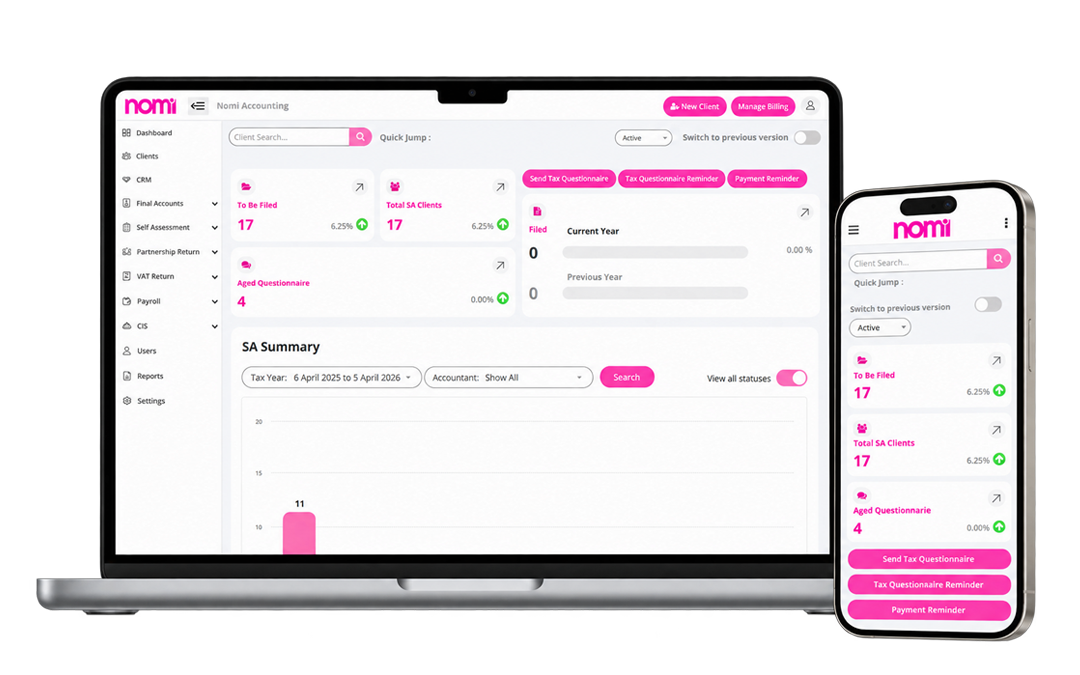
HMRC data integration
Import client tax data directly using secure HMRC APIs, including employment records, pensions, and SEISS grants. This improves accuracy and removes manual entry errors.
Practice management
Manage workloads with built-in practice management software, giving full visibility of staff tasks and deadlines. Assign work, track progress, and ensure nothing is missed during tax season.
Bulk client collection
Collect tax data using digital tax questionnaires that clients can complete online at any time. This reduces chasing emails and speeds up data collection.
NextGen mobile application
Improve communication with real-time updates, notifications, and secure document sharing. Clients can e-sign tax returns, view deadlines, and track progress.
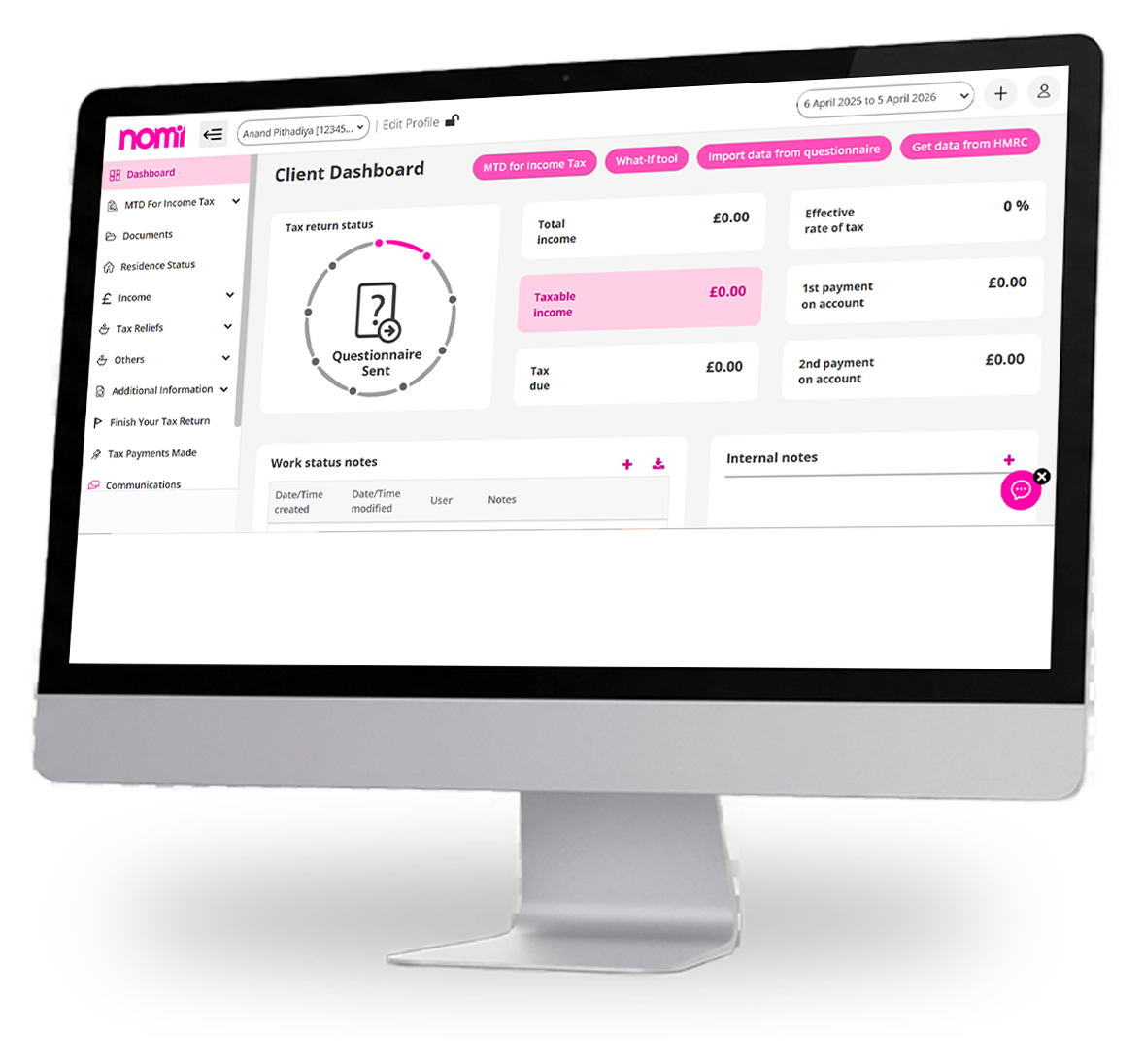
Making tax digital for income tax (ITSA)
Nomi helps your practice stay prepared for Making Tax Digital, with HMRC-recognised software built for digital tax management.
From maintaining digital records to supporting compliant tax submissions, Nomi provides the tools firms need to manage tax obligations efficiently and confidently.
HMRC Recognised Self Assessment software for UK accountants
Nomi is built as an HMRC-recognised self assessment software, helping firms stay compliant while reducing administrative workload.
What you can manage in Nomi:- Self-employment, employment, property, and partnership income
- Complex tax scenarios including foreign income, capital gains, trusts, and non-residency
- Direct HMRC submissions from a single platform
- Auto-filled tax calculations to reduce manual effort

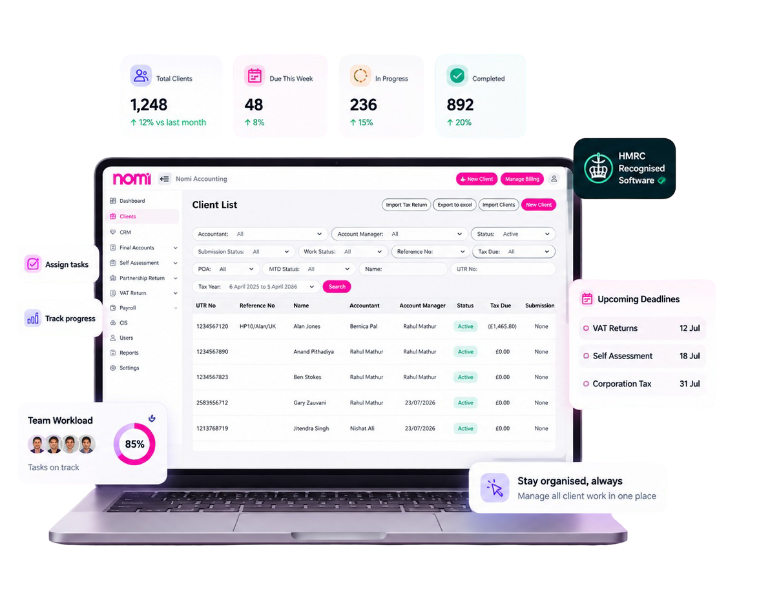
Task and workflow management
Nomi helps firms stay organised during tax season with structured workflow management built for accountants.
Key benefits:-
Automate task status updates across workflows
- Assign tasks easily to team members
- Track progress across all clients in one dashboard
- Reduce missed deadlines and bottlenecks
- Collect client data in bulk using digital forms
- Request eSignatures without additional tools
- Store documents securely in one place
Comprehensive Self Assessment tax return software features
Nomi supports complete compliance requirements for UK accountants and bookkeepers.
Key capabilities:
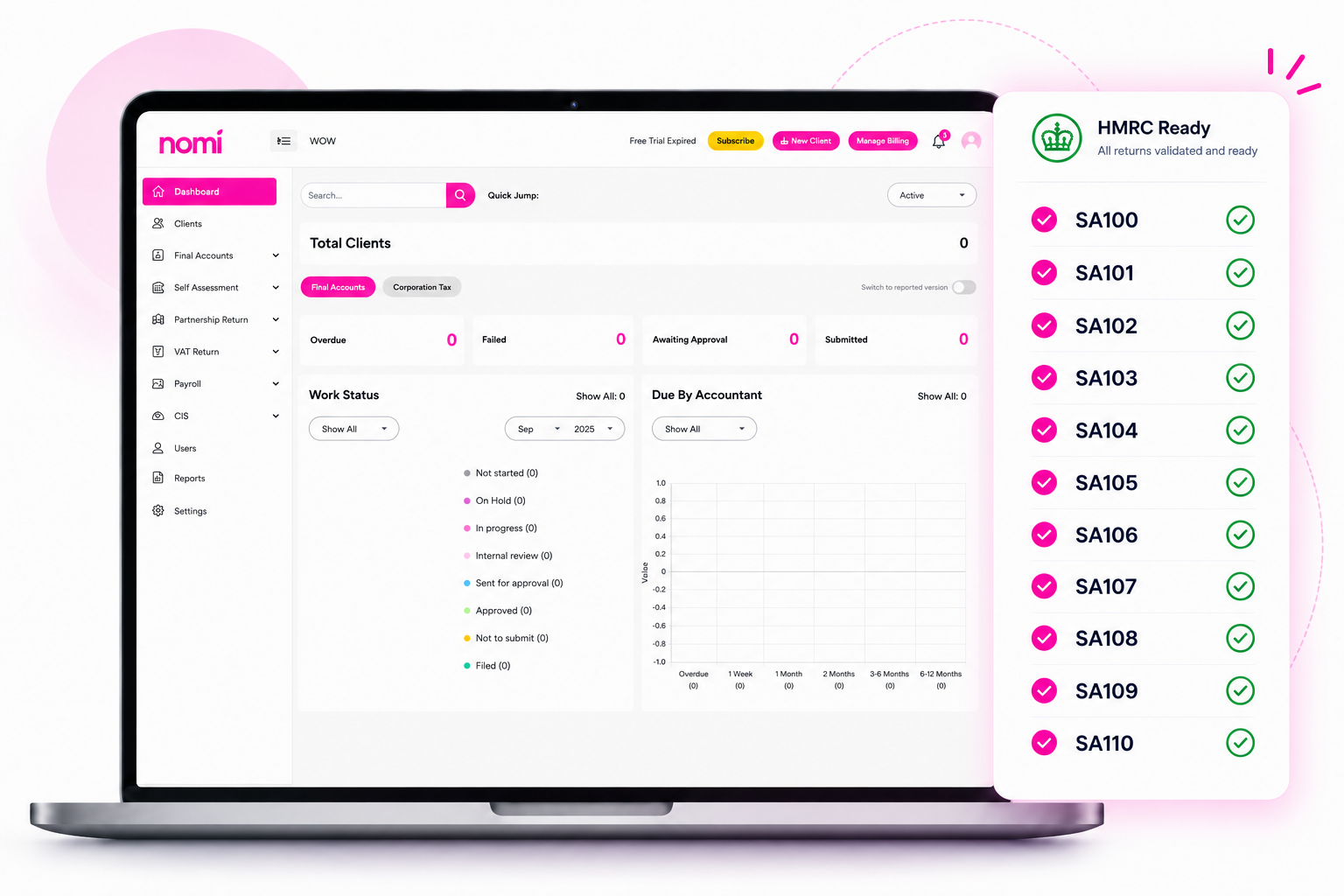
- Supports SA100, SA101, SA102, SA103, SA104, SA105, SA106, SA107, SA109, SA110
-
Integrates bookkeeping, payroll, accounts, and partnership tax data automatically
- Generates auto-populated tax records and documents along with SA 302
- Secure document sharing with GDPR compliance
-
Centralised storage for all tax records and submissions
This makes it a complete self assessment tax return software for accountants looking for efficiency and compliance in one system.
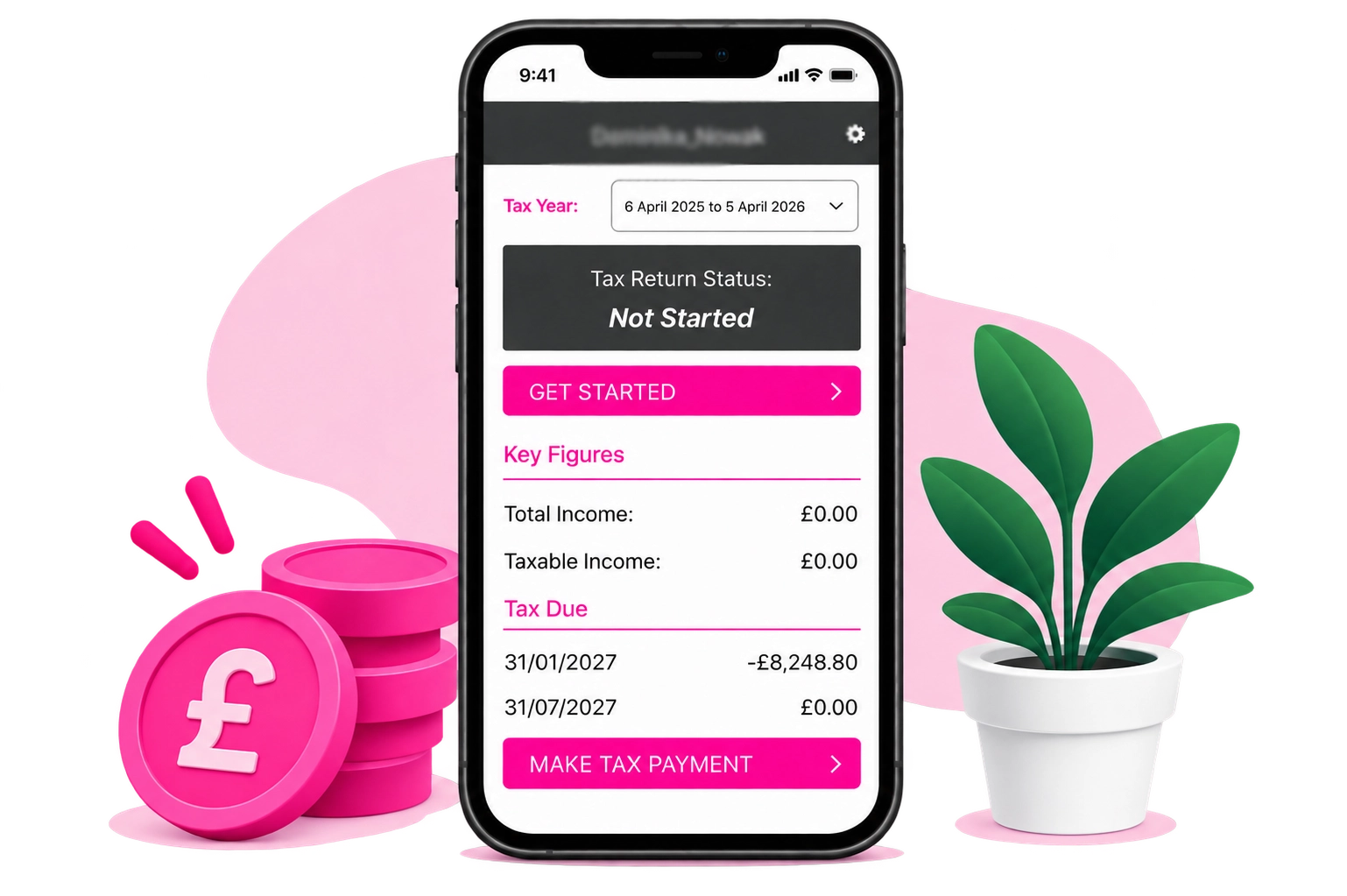
Go mobile with personal tax return software
Nomi also includes a mobile-first experience for your clients.
This improves communication and reduces delays during tax season.
Mobile benefits:- Real-time review of tax returns, reports, and HMRC forms
- Answer tax questionnaires and review schedules in real time
- Check tax payment liabilities and deadlines
- Built-in eSignature for faster approvals
- Real-time visibility of updates, checks, and tax information
How Nomi self assessment tax return software works
Nomi simplifies the entire tax return process from start to finish.
1
Collect client data through digital questionnaires
2
Centralise all client records in a single dashboard
3
Prepare self assessment and partnership tax returns
4
Review calculations and validate accuracy
5
Identify errors early before submission
6
Submit directly to HMRC and store records securely

Why firms switch to Nomi
Accounting firms switch to Nomi to simplify migration, reduce manual work and bring their tax and accounting workflows together in one platform.
Key reasons include:- One-click migration from Xero, QuickBooks and Sage
- Faster tax return preparation through HMRC integration
- Less manual data entry and duplication across workflows
- Better control of staff workloads, deadlines, and client work
- Connected bookkeeping, payroll, accounts, and tax data

It's easy to start using Nomi
Simple setup. No training headaches. Nomi is built for accountants and bookkeepers who want to save time from day one.
- ✓ Set up in minutes, not days
- ✓ Data is safe, secure & HMRC recognized software
Explore our other products
Choose the Nomi modules that suit your firm, including payroll software and accounts producton software,
and build a solution that works for you.

Payroll Software
Run payroll with confidence.
- Process payroll quickly and accurately
- Automatically calculate PAYE, National Insurance and pensions

Accounts Production Software
Prepare compliant accounts with ease.
- Create statutory accounts for companies and LLPs
- Produce accurate accounts ready for filing with HMRC and Companies House
Frequently asked questions
You can sign up for Making Tax Digital for Income Tax through HMRC if you meet the requirements. Before registering, you should have compatible software, understand your MTD obligations and check whether you qualify for an exemption. Nomi can help you manage your digital records and submit the required information to HMRC.
Quarterly updates are summaries of your business income and expenses that you send to HMRC every three months. They are not tax returns. If you have more than one self-employment or property business, you generally need to provide a quarterly update for each business.
Nomi lets you maintain your digital accounting records and prepare the information required for your quarterly update. You can review the figures and submit the update to HMRC using the MTD for Income Tax service within compatible software.
Yes. If you have multiple self-employment or property businesses that fall within MTD for Income Tax, you need to send quarterly updates for each relevant business. HMRC requires a quarterly update for each self-employment and property business.
You need to authorise your compatible software to connect with HMRC. The MTD sign-up and authorisation process may require you to verify your identity and connect your software to your HMRC account. The exact steps can depend on whether you are submitting your own updates or acting as an agent for a client.
Standard update periods follow the tax year, running from 6 April to 5 April. The quarterly periods end on 5 July, 5 October, 5 January and 5 April.
Calendar update periods run from 1 April to 31 March, ending on 30 June, 30 September, 31 December and 31 March. The deadlines for both options are 7 August, 7 November, 7 February and 7 May.
You still need to submit an annual tax return after completing your quarterly updates. The annual return brings together your income and expenses and allows you to add other income, claim relevant reliefs and allowances, and make required adjustments before submitting your final tax position to HMRC. Quarterly updates do not replace the annual tax return.
For the 2026-27 tax year, HMRC will not apply penalty points for late quarterly updates. However, you still need to send all required quarterly updates before you can submit your tax return. From later tax years, missing a quarterly update deadline can result in a penalty point; reaching four points can result in a £200 penalty.
Yes. Starting MTD for Income Tax from 6 April 2026 does not remove your obligation to complete your 2025-26 Self Assessment tax return. The deadline to submit the return and pay any tax due is 31 January 2027. Current penalties continue to apply to the 2025–26 tax return and payments.